
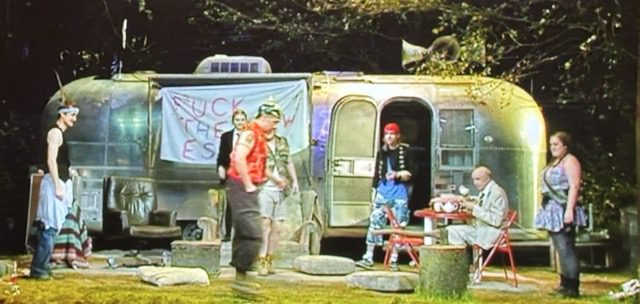
Delusion and defiance in Johnny Rooster are two defining traits that play a crucial role in the dynamics of the play Jerusalem by Jez Butterworth. Rooster isn’t merely a character; he’s a walking, talking rebellion against everything in society—he navigates his own world.
For Rooster, reality often bends to accommodate his desires and whims, making his delusional nature particularly striking. In Butterworth’s play, he embodies something more profound than just a narrative; he represents a psychological rebellion that challenges our understanding of mental boundaries. Instances of this psychological rebellion include his refusal to conform to societal expectations, his resistance to urbanisation, and his freedom to indulge in heavy drinking and drugs. Rooster’s conscious self-isolation leaves him so disconnected that he constructs an entire delusional mythology around his life: his encounter with a giant, his magical birth, and his special blood are just a few examples. He romanticises stories, contributing to his legacy, by selectively telling the truth and bending it, thus creating a larger-than-life image.
Rooster as a Charismatic Zealot
There are several key moments in the play where we see Rooster as a larger-than-life character. For example, in the opening description, the stage directions describe him emerging from his trailer almost mythically. He’s hungover yet powerful, drinking milk mixed with vodka and a raw egg before letting out a thunderous roar that echoes through the forest. Nevertheless, his story isn’t just another narrative about mental health. Instead, it’s a raw, unfiltered exploration of how we perceive reality when the lines between delusion and defiance blur beautifully and terrifyingly.
With each bizarre narrative and resistance to bureaucratic control, Rooster develops sophisticated survival strategies. For example, he creates a network of dependents by ensuring people need him—whether for drugs, alcohol, stories, or shelter. Also, Rooster carefully chooses when to rebel and when to superficially comply with authorities. He knows exactly how far he can push boundaries without triggering immediate consequences. He transforms perceived weakness into profound self-preservation, blurring the boundaries between delusion and defiance.
Before going any further, why not watch the following interview? In it, James Harding interviews Jez Butterworth, and they examine English identity and rural life through the story of Johnny Rooster, fuelled by hedonism, defiance, and a lot of swearing!
Johnny Rooster’s Delusions
At their core, delusions are complicated – very complicated. Delusions are intricate personal narratives that make perfect sense to the person experiencing them. They’re not random – they’re significant. Consider Rooster: his delusions aren’t just random dreams but elaborate mythologies that give his life meaning. When he believes he’s come from giants and has supernatural connections to the land, is it ‘real’ in the scientific sense? No. Yet, to him, it’s absolute reality. In this way, Rooster’s delusions serve as a shield. This helps him to make sense of a world that often feels messy and incomprehensible. These aren’t weaknesses – they’re complex survival strategies.
Rooster’s delusions in Jerusalem transcend his odd ways of thinking. They emerge as sophisticated coping strategies that blur the boundaries between perceived reality and internal mythology. In the book Power, Intimacy, and the Life Story: Personological Inquiries into Identity, Dan P. McAdams suggests that such elaborate personal narratives often emerge as a response to creating meaning and making sense of lives. In particular, this happens when people feel left out, hurt, or experience too much social pressure.
For Rooster, claiming descent from ancient giants isn’t mere make-believe. Instead, it’s a profound act of taking back, being defiant, and asserting personal power. This happens because he feels traditional societal structures have fundamentally failed him. Here, social rejection becomes Rooster’s playground. Most of us would crumble, but Rooster defiantly transforms marginalisation into an art form of self-preservation. He transforms his marginalised status into a source of strength. As a former daredevil and now a drug dealer living in a trailer in the woods, he’s rejected by conventional society. Still, he creates an alternative social space where he calls the shots.
Reality Versus Imagination
Reality is a tricky concept. Haven’t we all had moments of questioning what’s real and what exists only in our minds? Rooster takes this to another level. His perception isn’t just different – it’s a whole alternate universe where mythology and personal truth intersect. For instance, his character embodies the ancient spirit of England’s past—pagan, rebellious, and deeply tied to the land. At the same time, he’s a flesh-and-blood man resisting the advances of modern life.
Daniel Kahneman’s Thinking, Fast and Slow suggests that our brains are storytelling machines. We don’t just perceive reality; we construct narratives that help us make sense of our experiences. Kahneman argues our minds create coherent narratives even when presented with incomplete or contradictory information. Rooster’s just doing this on an epic, almost mythological scale. His delusions about being connected to ancient giants are not just random thoughts. Instead, they’re a way of understanding his place in the world, of giving himself significance beyond the immediate, mundane reality.
Furthermore, when traditional social structures fail to provide meaning or recognition, the mind becomes an incredible builder of survival strategies. Through this process, Rooster transforms his perceived ‘outsider’ status into a powerful mythology, where being different isn’t a weakness but a profound strength. Each of his bizarre stories and his resistance to bureaucratic control becomes a deliberate act of his psychological self-preservation.
As a result, he’s not just surviving but rewriting the rules of engagement. He defies societal norms and authority by challenging conventional power structures – the government, the police, or local townspeople – by refusing to conform to their rules. Instead, he establishes his own world of storytelling, rebellion, and escapism in the woods, drawing a group of young followers who see him as a leader and a legend. He coaxes them when offering his place as a sanctuary: “You can come here. Always. Day or night. Rain or shine. I’ll be here”.
Ultimately, his brilliance lies in how he defiantly turns marginalisation into a way of taking control by creating a delusional world so powerful that others can’t help but recognise his humanity.
Modern Drama’s Mental Health
Contemporary plays such as The Curious Incident of the Dog in the Night-Time or Every Brilliant Thing have emerged as a powerful lens for exploring mental health, significantly transforming clinical narratives into deeply human experiences. While traditional plays such as A Streetcar Named Desire or Equus often presented psychological traits as disorders, modern theatrical works like Jerusalem humanise complex inner landscapes. Johnny Rooster isn’t just a character with a mental health condition. Instead, he’s a nuanced exploration of how individuals construct meaning when societal frameworks fail them.
Playwrights such as Martyna Majok and Lucy Kirkwood are increasingly rejecting simplistic, biased stereotypes. Instead, they present mental health as a rich, multidimensional spectrum of human experience. Characters like Rooster demonstrate that what clinical frameworks might label ‘delusion’ can be a profound survival mechanism, a creative act of self-preservation. By presenting psychological complexity without judgment, contemporary drama invites audiences to expand their understanding of mental resilience. The narrative in Jerusalem moves past binary thinking – mental health isn’t about being ‘normal’ or ‘abnormal’. It’s about how humans adapt, resist, and create meaning in challenging environments.
Humanising Rooster
Moreover, Jerusalem accomplishes something revolutionary; it presents a character with delusions who isn’t a victim. Rooster emerges as complex, powerful, flawed, and absolutely magnetic. Through this portrayal, he challenges the typical narrative of depictions of mental health. Literature holds a unique power to humanise experiences that society often misunderstands. By revealing Rooster’s depth, Butterworth invites us to look beyond labels and diagnoses. Rooster isn’t a case study. Instead, he’s a multidimensional human whose inner world is as valid as anyone else’s. Contemporary drama finally does what good literature should – humanising complex psychological experiences.
Understanding Rooster’s Delusions
In Jez Butterworth’s Jerusalem, Johnny Rooster provides a profound reimagining of delusions as more than just a category of mental illness. More specifically, the play challenges traditional perceptions by presenting Rooster’s delusions as complex, meaningful narratives that serve as powerful survival mechanisms. Rooster’s elaborate mythologies – his claims of descent from giants and supernatural connections to the land – are not random fantasies. Instead, they are intricate psychological strategies for making sense of a world that has marginalised him.
Current psychological research supports this nuanced understanding. For example, the Review of Philosophy and Psychology argue delusions can offer psychological benefits by enhancing feelings of pleasure or by conferring purpose and meaning to one’s life. In particular, it is suggested that delusions emerge as sophisticated responses to trauma, social exclusion, and overwhelming pressures. For Rooster, his mythological self-narrative becomes an act of radical self-preservation. Where society sees dysfunction, he creates a world of individual empowerment that transforms perceived weakness into strength. In this way, his stories are not about escaping reality but creating a meaningful alternative that provides dignity and purpose.
Mental Shifts: Delusion and Defiance
Rooster’s representation of delusion and defiance marks a significant shift in how we conceptualise mental health. Modern dramatic works are moving away from stereotypical images that reduce individuals to their diagnoses. Instead, they invite us to see the rich complexity of psychological experiences. Rooster stands out not as a victim to be pitied but as a multidimensional human being whose inner world is as valid and compelling as anyone else’s.
Furthermore, the play ultimately suggests that delusion and defiance can be a form of resistance—a way of reclaiming power in a world that seeks to define and limit individual experience. By blurring the lines between imagination and reality, Rooster challenges us to expand our understanding of mental health. As such, we must recognise how people change and stay resilient.
Conclusion
Rooster teaches us something profound: our perceived limitations can become our greatest strengths. Mental health isn’t about fitting into predetermined boxes but understanding, compassion, and radical self-acceptance.
At the same time, Rooster’s story is more than just a character study. He represents a profound exploration of human resilience, mental complexity, and the power of personal narrative. Through his story, we discover that mental health isn’t about fitting into predetermined societal expectations but rather about understanding the intricate ways individuals construct meaning and survival strategies.
Audience Mental Health Awareness
The beauty of characters like Rooster lies in their ability to challenge our fundamental understanding of psychological experience. They remind us that what society often labels dysfunction can be an incredibly sophisticated mechanism of self-preservation and resistance. Mental health isn’t a linear narrative of recovery but a dynamic, ongoing process of negotiating identity, challenging systemic limitations, and creating personal mythology.
By embracing the complexity of psychological experiences, we open ourselves to more profound empathy and understanding. Rooster teaches us that our perceived vulnerabilities can become our greatest strengths. Through this understanding, we learn that the stories we tell ourselves have the power to reshape our reality. Ultimately, his narrative invites us to look beyond diagnostic labels to see the rich, nuanced humanity in every individual’s psychological landscape.
Experiencing Delusion and Defiance
If you recognise any delusion and/or defiance patterns in your relationships or friends, please remember that help is available. Don’t hesitate to reach out to a mental health professional. Information is available on the NHS website, or more information can be found on the information sheet Delusional Disorder, which gives an overview and lists the symptoms. Alternatively, you might find the NHS Oppositional Defiant Disorder (ODD) factsheet helpful – a condition commonly seen in young people with ADHD. Whilst Rooster might be fictional, delusional disorder can cause people to feel confused, isolated, anxious, misunderstood, frustrated, and resistant to contrary evidence.
Your reality matters, and your perception shapes your truth. After all, the most profound truths are found in the spaces between what society considers ‘real’ and what we personally know to be true. Want to share your thoughts? Comment below! Let’s continue this conversation and challenge those narrow definitions of reality together.
For more blog posts on delusion, see Does the Powerful Duke Have a Narcissistic Personality Disorder?
More Literature Featuring Delusion and Defiance
Why are these plays important? These three plays explore delusion and defiance profoundly. Equus examines religious worship and passion through a disturbed boy’s defiance of societal norms. A Streetcar Named Desire portrays Blanche’s self-delusion as a defence against reality. The Glass Menagerie depicts characters trapped in fantasies, defying their restrictive circumstances through escapism.
Equus by Peter Shaffer
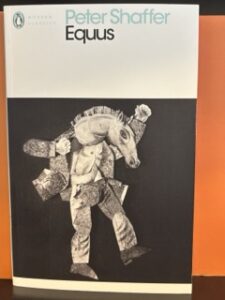 Peter Shaffer’s provocative play Equus delves into the complex psychological landscape of Alan Strang. In particular, he is a troubled young man who commits a shocking act of violence against horses. Initially, the narrative explores Alan’s profound delusion, transforming horses into objects of intense religious and sexual worship. Shortly after, psychiatrist Martin Dysart becomes fascinated by Alan’s intricate psychological world. Through this exploration, he recognises that the boy’s ‘madness‘ is a form of passionate belief that challenges the conventional understanding of sanity.
Furthermore, Alan’s delusion serves as a powerful metaphor for human passion and repression. His ritualistic worship of horses represents a desperate attempt to create meaning in an emotionally sterile world. As the story unfolds, Dysart questions whether ‘curing’ Alan means destroying his unique, albeit disturbing, spiritual experience. Consequently, through this exploration, the play masterfully blurs the lines between mental illness and profound, albeit unconventional, spiritual connection. Ultimately, the audiences are left to contemplate the nature of normality and individual truth.
A Streetcar Named Desire by Tennessee Williams
 In Tennessee Williams’ A Streetcar Named Desire, Blanche DuBois emerges as a quintessential embodiment of delusion. Specifically, we see her desperately constructing an elaborate fantasy to shield herself from harsh reality. Upon arriving at her sister Stella’s cramped New Orleans apartment, Blanche weaves intricate lies about her past. In doing so, she fabricates a narrative of genteel sophistication to mask her profound psychological fragility and traumatic experiences.
Indeed, her delusions manifest as a survival mechanism. Through these delusions, she meticulously crafts an image of youthful beauty and social refinement despite her rapidly deteriorating mental state. As the story progresses, Blanche’s denial becomes increasingly dramatic, particularly in her interactions with Stanley Kowalski, who systematically dismantles her fragile illusions. Consequently, her ultimate psychological breakdown represents a profound collision between her constructed reality and brutal truth. The play brilliantly explores how delusion can be both a protective mechanism and a destructive force.
The Glass Menagerie by Tennessee Williams
 In Tennessee Williams’ The Glass Menagerie, Laura Wingfield embodies a profound psychological delusion rooted in intense social anxiety and self-isolation. More specifically, her fragile inner world is symbolised by her collection of delicate glass figurines—a metaphorical extension of her vulnerable psyche. Laura’s delusion manifests as a complete withdrawal from reality throughout the play. As a result of this withdrawal, her delusion constructs an intricate fantasy realm where her physical disability and social fears become manageable through imagination.
Additionally, her mother, Amanda, perpetuates this delusion through her fantastical narratives about Laura’s potential future. In fact, she refuses to acknowledge her daughter’s profound psychological challenges. Subsequently, when a gentleman caller briefly enters their world, Laura’s carefully constructed illusions shatter like her beloved glass animals. Thus, these illusions reveal the devastating fragility of her internal landscape. Williams masterfully depicts delusion as both a protective mechanism and a destructive force.
Continue Your Journey: Personal Development, Delusion and Defiance
You’re not alone in this. These reads may help you explore, reflect, or take the next small step.
Looking to Enhance Your Reading Experience: Thoughtfully Chosen Accessories for Deep, Emotional Reads
Because reading about complex lives should come with simple comforts, discover accessories that support your experience.
- Lastar LED Floor Lamp, Reading Standing Lamps with Remote and Touch Control for Living Room, Bedroom, Office with 4 Color Temperature & 5 Brightness Levels, 60 min Timer & Memory Function
- SLIGUY Reading Pillow for Sitting in Bed Couch Adult, Back Pillow with arm Support and Pockets, Adult Back Pillow Bed Chair for Bed Rest, Reading, Watching TV, Gaming for Boys and Girls Light Grey
These are items I highly recommend. If you purchase after clicking on one of my affiliate links, I will earn a bit of coffee ☕️ money, which I promise to enjoy while reading and researching for my next blog, continuing to support you on your journey. You do not pay a higher price! 😊
Subscribe to My Newsletter
Welcome, and join me and a community of fellow book lovers!
As a thank you, when you sign up, I’ll also send you my personal reading list: a selection of books, poems, plays and short stories that explore mental illness in all aspects of life.